robert schuler:
I simply reach over and play the bass notes with my finger. Robert...
Me too.
I am not an expert on noter and drone but I do what Robert first recommended. Just briefly tuck the noter under your ring and little finger and poke at the other strings with the other fingers. I use this frequently with my little dulcimers tuned Dad because Daa gets kind of sqeaky at the upper reaches.
I have three stands from Lee in Ohio, but I need two more quickly. Can anyone point me to a stand I can buy quickly, even a guitar stand off of amazon? If this isn't allowed on here, please PM me. I need something quickly. Thank you!
Just because it's a favorite topic for me, I always wanna know!
Right now I have a huge stack of books going but am also embarking on reading about poverty. I am reading Irresistible Revolution and adding Toxic Charity, Poor Economics, and A Tree Grows in Brookland.
Already going = The Association of Small Bombs, The Pearl That Lost It's Shell, Big Magic, and Romans....
Is it too much to share that we have a water stain in our living room ceiling that looks like a very artsy rendition of male anatomy? And you know how people see Jesus in a cheese cracker? Well, WHAT DOES IT MEAN? LOL! ~I do have a pic, I'm just too embarrassed to share it~
I guess you see what you want to see. Some people want Jesus, and some want . . . 
It really is amazing! Even our Pastor says we should charge people to see it! LOL!
Margaret Wright's 12-Tune Song Books. I learned on them, I love them, they are actually a crutch to me~LOL! I NEED MORE FROM HER!!! :)
I have met quite a few Daves, and they were all spectacular! It's been a very long time, so sadly I don't remember everyone.
Is it too much to share that we have a water stain in our living room ceiling that looks like a very artsy rendition of male anatomy? And you know how people see Jesus in a cheese cracker? Well, WHAT DOES IT MEAN? LOL!
~I do have a pic, I'm just too embarrassed to share it~
Currently in the works for me is a Feather Dulcimer, and I am beside myself with excitement!
ETA I figured y'all might be tired of my first dulcimer story bought sight unseen nor heard? It was a gloriously life-changing experience! Via YouTube I have heard the Feather Dulcimer.
I see there is not much activity here, as we head into August! I am needing a KICK in the pants, as I truly need to take my health back. I have ideas and plans, but I truly think I'll be most successful after weaning my toddler in a few months....
Thanks you! Johnny Pledger really did a great job...pictures really don't do it justice...I've been having some problems trying to post pictures...will post as soon as I can.
Steven
Sound like a great looking Dulcimer. Got any pictures to post?
Just received my first custom built dulcimer today! It was made by Johnny Pledger of Trion, Ga and it's a real beauty! It's all cherry with black fret dot inlays, crescent moon soundholes on the upper bouts, kicking mule soundholes on the lower, a wenge accent strip on the back, and ebony bridge and nut. The peghead is the classic cherry, but the body and fretboard look like the sapwood...different color variations and swirly grain patterns with a few worm holes. Pictures will follow. The dulcimer sounds great! It's a bit brighter than my Pledger all-walnut dulcimer.
Johnny did a great job and I recommend him!
Steven
Jan, if you don't have Anne Lough's Celtic Treasures or Joe Collin's Simply Celtic, and you love Celtic, then yes, by all means, get those books! They are both fantastic!!
Hmm...I'm currently at Dulcimer U at Western Carolina University with Larry Conger, Ann Lough, and Joe Collins.....maybe I'd better take another look in the vendors' area!
While I completely agree with Rob’s bottom-line point (don’t be afraid to challenge yourself) I have a couple comments I’d like to make. :)
The first is that just because you *can* play a 29” or 30” VSL dulcimer doesn’t mean you *prefer* to. In my own dulcimer journey, I’ve played instruments with many different VSLs, from little micro-instruments to those with a 30” VSL. As I’ve done this over the years, I’ve slowly come to the realization that, although I *can* play instruments with VSL’s ranging from micro to 30”, I much *prefer* to play instruments with VSLs between 25.5” and 27”.
The second is about the idea that a dulcimer with a longer VSL will have more volume and deeper tone. This has been stated more than once in this thread, but from my experience, this does not have to be the case. Yes, that’s true when comparing against tiny travel instruments, but full-size instruments with shorter VSLs tend to be louder and more resonant than their longer VSL cousins and typically have more attack (likely due to increased string tension). It’s been my experience that if the instrument is otherwise full-sized, you really don’t lose anything with VSLs down to about 25”. Beyond that and I think sustain and the tone at frets above 10 or 12 start to audibly suffer.
My loudest and most resonant instrument by far is a Gallier Starsong, with a 26.25” VSL (it’s actually the loudest dulcimer I’ve personally ever heard, and I’ve heard a bunch). My second loudest and most resonant instrument by far is a Modern Mountain Dulcimer with a VSL of 25.5”. These are in another league entirely compared to the bunch of other dulcimers I own, including custom instruments with 29’ VSLs, or other Modern Mountain instruments with longer VSLs. I recently spoke to a friend of mine who is a distributor for David McKinney’s Modern Mountain instruments, and he told me (unsolicited) that it’s very common for the shorter VSL (but full-size body) instruments to be louder and more resonant. I've experienced the same thing with McSpadden's 26" VSL (but full-sized) dulcimers compared to their standard dulcimers with a VSL of 28 1/2".
I also think the idea of VSL is, in general, probably less important to chord/melody players (for whom the "small hands" idea is most relevant) than it is for noter/drone players. When you're playing noter/drone, you've got open strings that are actually vibrating along those longer lengths. When chording, this is clearly not the case.
To me, the issue reminds me of economy of motion. Just like a player should theoretically be moving his/her hands no more than necessary to get the desired result on the instrument when fretting, strumming, etc, there’s also no need to stretch farther than you need to “just because”. There are no bragging rights because you can pull off an A chord on a 30” VSL instrument. If you can get the tone and volume you like out of a shorter scale instrument, I say go for it.
Julie! I am in Larry's book RIGHT this second, haha! Have you played Bridget Cruise. I'm getting obsessed with this tune. I'll look into Bill 's book too!
Ken, haha, maybe one day! I am amazed at folks who can play by ear and memorize so well. Waaay out of my league! I have Sue's book but haven't gotten much into it YET. It looks amazing.
Sue Carpenters 'Patterns and Patchwork' up until I started using a tablet which contains books, smn, and audio files.
Tab books? Never use 'em. I have lyrics pages for maybe 30 songs that I play frequently at Open Mics, and at the top I have tab for the opening bars of the song. I just don't play from tab.
This was from a page about reach in piano playing ( http://www.pianoworld.com/forum/ubbthreads.php/topics/1900021.html) , but, just substitute 'dulcimer' for 'piano' and 'keyboard' and I think, it could apply here too - as an approach to the whole thing ... although, as Lisa says, you need to factor in arching the fingers...
Start with the shoulders and make sure they are tension free, then the elbows, relax on down the arms, limp wrist will drop down from the end of your arm, fingers will spread loosely to create a natural curve. It's a feeling like you have no bones!
Then whatever music you are playing lift your forearms up without lifting your shoulders, drop onto the keyboard and start the music playing.
Check several times during your practice to see if your shoulders are up around your ears. You will notice a lot about yourself if you make yourself the subject to notice instead of the focus on the music. Play something you know to check this out. Start and stop without producing tension - What did you catch yourself doing?
And, I wouldn't force any additional movement into the webs of the fingers except to maybe gently place the opposite hand between each of the four webs per hand and moving gently to the bottom of the web and "rocking" between the expanded web minimally.
Then I think splaying the webs apart without forcing by sitting on the bench at the piano with your hands parallel to your knees in curved hand position no tension. Again, just a bit of slow opening of the webs 3 - 5 times all at once without splaying the finger tips . You will feel the reaction in your fore arms and I think it causes a very unpleasant feeling on the outside of the forearm. This is just to make the webs flexible should you need expansion between fingers for wider intervals. Don't be excessive in any movement.
Comforting hands by a little massage after a workout is easier to do with a little lotion. I sometimes say aloud "Good hands, nice hands" when I'm amazed at what they were able to do.
Excellent points, Lisa. I see a lot of dulcimer players whose fingers are flat on the fingerboard. Arched fingers when typing, arched fingers when playing a stringed instrument. 5 fingered fretting is also something that most dulcimists don't do. I rarely use the thumb (unless I'm doing my Alan Freeman imitation) but I use the little finger a lot. I assume that's from being a guitarist long before I had a dulcimer.
Exercises: try to make a straight line with your thumb and little finger. Then try to make a 90 degree angle between all your fingers. To help with the arched fingers hold your hand out fingers extended then bend fingers at the middle knuckle holding them tightly then relaxing them.
DT, great points, as usual. True, I don't want to compel but rather to lead, to let folks know they can do more than they originally thought they could. In college I took jazz guitar lessons from a real Chicago jazzman. For the 1st lesson he handed me a sheet of paper with about 18 or 20 finger-twisting chords. He said, "2 beats each for next week." I worked and worked on them all week. When I returned for my 2nd lesson. I played them for him and he said it was good. Then I said something to the effect that boy they were really tough. I've never forgotten what he said next. "That's what I give an absolute beginner for their 1st lesson." He read the incredulity in my face, laughed and said, "you see, you know they're hard. A beginner doesn't know they're hard; a C chord is hard for them." When you start out, beginners, don't limit yourself with what you think you can play. You can do more than you think you can.
I'm finding I just can't seem to put down Joe Collin's Simply Celtic book and Anne Lough's Celtic Treasures. They stay out and I'll stop what I'm doing to go over and just play one song...or two...or three...or ...
What tab books are your most tattered from use? It's always good to hear about some wonderful books!
Great thread!
I'd like to bring up two other points that may not have been mentioned yet-
1) I see a lot of beginner dulcimer players struggle with making chords- having a hard time both making the reaches and also with weak fingers and hands that don't effectively fret. If you have this problem, be sure to check the ANGLE of your fingers as you fret . Many beginners fret with their hands horizontally held low- like a pianist or like someone typing on a computer keyboard. As any violin teacher will tell you, it's important to raise your hands up in an arch so that your fingers come down onto the strings from straight above and you use the tips of your fingers to fret effectively. The mountain dulcimer makes this super easy because it lies flat and we fret it from above already. Fingers and hands held low/flat/sideways and fretting with the fat pad of the fingers make weak sounds and can't make stretches as easily. Read my blog post about " Lazy Fingers " and see if you can improve your hand/finger position and angle.
2) I hope that everyone who is having a hard time making chord stretches is actually utilizing their thumb and their pinky as well? I see some people playing chord style dulcimer using only two or three fingers of their left hand. That really limits the notes you can reach... similar to typing with two fingers.
Guitar, mandolin, and banjo players usually do not fret notes with their thumbs. But we mountain dulcimer players have a huge advantage there, because we don't need our thumbs to wrap around and hold up the neck of our instruments...instead our instrument lies right in our lap or on a table or stand and our entire left hand and all its 5 fingers are FREE to use in making chords and stretches. Take advantage of this gift and USE your pinky and thumb for fretting too! Do a few simple hand exercises every day to strengthen and stretch all your fingers- it works over time and really does make a difference. 
Lisa, I don't think the tenor of Rob's original post was to compel anyone to do anything. Rather, it was encouraging people to play a while (perhaps a year or more!) before deciding that a standard size dulcimer is too big for them. The muscles in your fingers take a while to develop, and he didn't want people giving up too early and never learning to appreciate the deeper tones and greater volume that larger instruments bring to the table.
I probably played the dulcimer for 18 months or more before I was able to play the 1-2-4 chord. I went through the stages of not being able to play it at all, to playing it sloppily and in pain, to finally being able to play it cleanly and comfortably. I did exactly what you say, playing other voicings of the chord such as 1-0-1, rather than giving up, and although I didn't really work on stretching, just the act of playing regularly helped develop the muscles I needed to play that one difficult chord. Perhaps because I had played the guitar for years and remembered not being able to play barre chords and thinking that I never would, I did not give up and buy a little dulcimer, but was patient and kept working at it until I got to the point where a 27" or 28" dulcimer is perfectly comfortable to me (though a 29" is probably not).
Here's a place to start with stretching exercises: http://www.musicianshealth.com/stretches.htm
What I like about that page is it includes arm and shoulder stretches, not just the hands.
If your heart is set on playing chords on a longer-scale dulcimer, there are ways to ease into it. You can play 2-finger chords, leaving one string open to drone. Also you can play further up the fretboard where the frets are closer together -- play your B-minor chord as 4-4-6.5 instead of 1-2-4.
You might find it easier to play chord/melody in DAA tuning (1-5-5) rather than DAd. That's because the DAA scale starts on the 3rd fret, not the open string, which puts you that much further up the fretboard. A capo on the 4th fret makes for easy playing, but then you might as well have started with a short-scale dulcimer to begin with so maybe the capo is cheating. Still an option, though.
See, folks, it's not like I've never spent time chording a long-VSL instrument :) If you want to do it, great. Pursue the goals that are important to you and don't let anyone talk you out of them.
Still (grumble, grumble) I think the tool should fit the user, not the other way around. I just read that roughly 10% of the stone tools archeologists dig up are designed to be used left-handed, which is evidence that the % of people who are lefties hasn't changed for tens of thousands of years. And, ahem, it means that humans make tools to fit themselves, not some generic average user. If a left-handed neolithic cave-dweller (a good way to describe myself, truth be told) doesn't feel compelled to use a generic stone hammer, why should any of us feel compelled to play a "standard" dulcimer if it doesn't feel right?
YMMV as always. Play happy. 
Jennifer, I used to know some exercises on the guitar. It was a series of scales, and each one forced you to stretch a different finger.
The only resource I can think of off the top of my head is Mike Casey's Hands-On Dulcimer . It is a technique book for both right and left hand. It is definitely not the kind of book you work on beginning on page one and moving forward, but you find the exercises to help with whatever you want to work on and concentrate on those. I would bet if you started on the beginner left hand exercises in that book you would already see some progress. And then you could work your way up to the finger independence chapter. It's kind of pricey new, but you might get lucky (I did!) and found someone selling a copy online either here or at Everything Dulcimer.
Any chance you are going to Redwood Dulcimer Day next month? It's down in between San Jose and Santa Cruz so it's not that far from you.
Thanks everyone ... Quite a lot I've never heard of... Listening research to do!
Redwing or Union Maid as it is sometimes called, is one of my fun to pay tunes.
I'll add "Paddy West" and "Cluck Ol' Hen"...both fun played noter/drone.
Steven
|
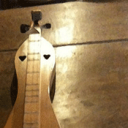
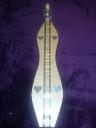
Teardrop mountain dulcimer, Robert Worth, 08/89, number 31. See pics for details. Back has two spots that look separated, but tight. Sound great. My best guess is spruce top, or maybe butternut? Sides and fretboard appear to be rosewood. My best guesses. Has six tuners but I use three strings. Bridge has a chip that doesn't bother me since I use just three strings. Tuners hold well. Some wear near Eagles. 35"x7/12". VSL 25 3/4".
|
One of my favorite "fun" pieces is Arkansas Traveller. Fun for both hands. :)
Going Fishin' is a copyright song. I have not recorded it.
Ken
"The dulcimer sings a sweet song."
I think I agree with everyone. 
The closest ting to a Fakebook for dulcimers are the various Join the Jam books by Stephen Seifert. And there are several of them, the original two volumes in both DAA and DAd, one on Gospel tunes, one that plays across the strings in the "low octave," and more recently a couple of video series where you can watch him play while you play along.
And there are lots of free resources online. On the "Resources" page of my website (don't worry; I have nothing to sell, so I'm not trying to drum up business) I have a category entitled " Free Dulcimer Tab Online ." Follow those links and explore!
But as Strumelia says, dulcimer players do not exist in a vacuum and many of us play with other musicians. There are lots of bluegrass and old timey fake books that might also be of interest. She describes them well. The online versions allow you to play either fiddle versions or midi files so you can hear the basic melody. (I have links to some of them on my website, too.) And because certain songs are often played in a standard key, I think it's good to learn the songs in that key. Soldier's Joy is indeed usually played in D ("hooray" says the dulcimer chorus), but Red-Haired Boy is usually in A, Temperance Reel is usually in G, and so forth.