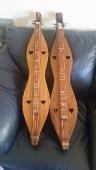
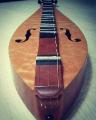
Do you have a pre 1989 FolkRoots or CapriTaurus dulcimer (made by Howard Rugg)?
Instruments- discuss specific features, luthiers, instrument problems & questions
Hi Patricia,
I am listening to that one now - thank you!
Tricia
Hi Patricia,
I am listening to that one now - thank you!
Tricia
Hi Tricia,
So glad you found the podcast! You might be interested in hearing the episode with Howard Rugg, one of the co-founders of FolkRoots and CapriTaurus: http://dulcimuse.com/podcast/resource/010.html
Those old FolkRoots dulcimers sound great ... you're lucky to have one!
Thanks for listening,
Patricia
I am seeing this some 2+ years later, but I'm delighted to find your podcasts are still available for listening. Thank you so much - this is wonderful ! I got my Folk Roots dulcimer from Elderly Instruments in Lansing, MI in 1986, and love it to this day. I'm really looking forward to listening to more of the podcasts over the next while.
I am seeing this some 2+ years later, but I'm delighted to find your podcasts are still available for listening. Thank you so much - this is wonderful ! I got my Folk Roots dulcimer from Elderly Instruments in Lansing, MI in 1986, and love it to this day. I'm really looking forward to listening to more of the podcasts over the next while.
Hearts of the Dulcimer Podcast - Episode 37
Golden Ring: A Gathering of Friends for Making Music
The 1964 LP Golden Ring: A Gathering of Friends for Making Music became one of the most popular recordings of the early folk music revival. In this episode, find out why Golden Ring was a groundbreaking album for the mountain dulcimer.
Hearts of the Dulcimer Podcast can be found on most podcast apps.
Here's the link to Hearts of the Dulcimer on iTunes: http://bit.ly/hotdpodcast
Don't use a podcast app or iTunes? You can listen to all the podcast episodes directly on our website: http://dulcimuse.com/podcast
We also have a resource page for every episode, where you can find photos, videos, and song lists. Here's the resource page for this episode: http://dulcimuse.com/podcast/resource/037.html
Thanks for listening! :-)
They are the kindest people I've ever met at the Dulcimer Shoppe. Jim takes such great effort in everything he does, and goes out of the way to meet needs and wishes. I'm looking for a 3rd dulcimer to add to my dulcimer family, and had thought about changing makers, just for variety, but I most likely will end up getting one from Jim again, just because I love not only their product, but their attention to detail and customer happiness. Maybe the notice of the standard policy change was with us frequent flyers in mind that know his instruments are generally in DAA (GDG for Gingers) unless otherwise requested.
Perhaps the concern is more about letting the dulcimer community know and hoping it understands than anything internal to their production practices.
It's not even the bridge, Dusty; I don't believe they really intonate for one tuning over the other. It might be the string set, if anything. Personally I don't see an issue, or what all the fuss is about. I know how to use the tuners to tune the strings to anything I want within the properties of the strings
Interesting, but no surprise, I suppose.
I am curious why Jim Woods states the change has not gone smoothly. Isn't the only difference which bridge they use? You would think they would have a bunch for DAA and a bunch for DAd, and they just have to switch which pile they grab from. I must be missing something here.
Interesting, in that in another topic we have a discussion about 'tradition'. Yes, some traditions never change and some do over time. ⌛️
For many years McSpadden's policy was to set up all standard dulcimers in DAA, with setup in DAd available on request. That has now changed. Below is an excerpt from an email I received from Jim Woods at McSpadden.
"...we have just this month changed that policy. Now well over 90% of our standard dulcimer are sold in DAD tuning so we have yielded to the pressure and made that the default setup. I’m still working on getting that news out to the dulcimer community. Trying to implement a change like that in a policy that has been in place for 56 years doesn’t go smoothly."
I am ordering these:
Keyboard case
I appreciate the suggestions but I'm really only interested in a hard-shell case that I can buy somewhere. If the Cedar Creek case turns out to be my only option, I'll go that way.
I also thought of gun cases. They're durable and long, and might work very well. The only possible problem might be taking them onto aircraft. After all, what would YOU think was in that case? 
Other than Dusty's suggestion, just get a half sheet of 1/4" ply and some foam, make one.
That's a tough one. The standard "large" hardshell dulcimer case is about 40" long. You can probably get an extra inch or inch-and-a-half since the interior is plush lined, but I'm pretty sure 43" would be out of the question.
If you don't plan on traveling on an airplane with the instrument, you might try one of those gun cases with the adjustable foam. The foam is pre-cut into small squares, and you remove the ones to fit your instrument. (I think they call it "pluck to fit" or something like that.) They come in different sizes. One is exactly 43" wide, but if you put the dulcimer in at an angle it might fit. I think they also come in 46" and 52" lengths. Here is one at Amazon .
Hi folks, new guy here. I own a few mountain dulcimers, and one of them needs a hard-shell case. It's a 43" long by 7" wide Edsel Martin teardrop. I've looked all over the internet but I can't find a case that's long enough. Back about 15 years ago, Cedar Creek built a case for my other Edsel Martin and charged me $200. I inquired with them on this one and they want $500 now. I'm hoping to find a less expensive option. Does anyone here know of either a case that would fit or of a place I could order a custom case for a more budget friendly price?
Zaulden, I not only moved the thumbrest all over the place to try different methods, but I even wrapped a rubber band around the thumbrest and my finger to try to get a good hold. I have small hands and short fingers, and the G pipe was about my limit because of the holes being further apart.
I wound up having way more fun on my pennywhistles, so I guess one day I'll sell my G tabor pipe.
Zaulden, I played the tabor pipe and tabor drum together, but I never really got past the "Mary Had a Little Lamb" stage. It was hard to coordinate the left and right hands... but way harder just hold the G tabor pipe so it wouldn't drop on the floor and break!
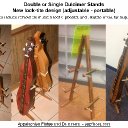
Thanks for the post @elvensong. I designed my stands to fit tight spaces, between my chair and desk, etc. They occupy 16 sq in. of floor space, and I can lift my dulcimers straight up for easy access. The stands lock for stability, and are padded with rubber tubing and felt to protect my dulcimers. They also fold up for easy travel.
Just went prowling online & 16.5 inches definitely would have blocked the t.v. screen (horrors!) & the shortest rack's a bit too long. I posted it just as a way to do a custom fit. Personally I prefer wood to the utilitarian look of a rack. Still your rack is another answer fitting the discussion topic & should fit many situations & tastes.
I use a guitar rack but it's full. @jack-ferguson makes a nifty double dulcimer stand
Cool, simple solution, Jack, but I can tell it wouldn't have fit the space I had. <sigh!> This was a custom fit for a fairly limited space with next to no width (the double stand would have been impossible & probably the guitar rack) & the rack looks long.
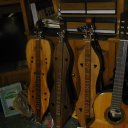
This discussion is slightly closer to what my husband just built than the similar "Dulcimer Display Stands - What do you use?" I've no wall space to hang my dulcimers and no instrument stands not in use with my guitars or husband's banjos. I'd been standing them up next to the bookcase seen in these photos or laying in another spot. They fell once too often and my husband started talking about putting some instruments away! 
He could tell that discussion was going nowhere.
This is his creation using spare wood, stained (oh yeah, some got spilled coming up from the basement), he cut the holes using his jigsaw, and he cushioned the holes using window draft sealer which comes in a strip of foam rubber with adhesive on the back.
A 4th dulcimer I call "the Orphan" lays in the space at the bottom between dulcimers and bookcase. It's the dulcimer that started me on my D ulcimer A cquisition D isease as I found the poor thing abandoned in a flea market. It's not well-made, but I keep it in Aeolian for rare use or offer to loan it out explaining it's my least valued. I also have a small inexpensive travel dulcimer in its case.
Keeping your instruments handy can be hard if your musical "petting zoo" is large, but if not locked away they are more likely to be picked up and played on a moment's notice.
Hi Zaulden, and welcome to FOTMD!
The only tabor pipe I've ever gotten was a polymer Susato in low G as well, like the one you have. I had listened to a lot of Youtube videos of pipe and tabor, and it struck me that the normal high D ones did indeed sound very shrill to my ears, like fifes. I also noticed they were played outdoors most of the time to accompany outdoor celebrations or dances. Fifes are usually played outdoors for marching. Maybe that's a sign! lol Anyway, i much preferred the sound of the lower tabor pipe. I have not played mine in a long time though- I switched to penny whistle and have enjoyed sticking with that instead... for me it was so much easier to hold and finger.
Perhaps a Bb or C tabor pipe would be easier on your ears than going all the way to the more common high D ?
"A fond kiss." (by Eddi Reader) Smitten by the whistle, the very first time I heard this song. I don't know if it's a penny whistle or tin
Thinking of y'all playing makes me smile.
A friend and I played on her screened in porch overlooking her lovely flower garden. But we were soon overpowered by the neighbor's weed eater. No problem, though. We had a great time and lots of laughs. Music heals the soul. Dulcinina
When I was at a concert of an Irish band (Geraldine McGowan and band) in 2004 I was so fascinated by the whistle player and the beautiful sound of especially the low whistle that I immediately had the wish to buy a whistle.
Since I have learned to play the recorder when I was a child and kept playing it all my life in recorder ensembles it was not difficult for me to learn how to play the whistle.
What was different compared to the recorder playing was the typical Irish ornamentation like cuts, strikes, rolls, crans and slides and to not tonguing every tone.
I started with a Clare high D and "worked" myself down to an Overton (Colin Goldie) low D.
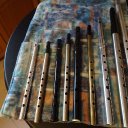
Please find attached a picture with my whistle collection (from left to right):
high D: Overton (Colin Goldie), Mac Nic, Susato
high C: Mac Nic
high Bb: Tony Dixon
low A: Mac Nic
low G: Ian Lambe
low F: Tony Dixon
low D: Overton (Colin Goldie)
I love all of them and every one has its specific sound and need of breath.
The Mac Nics are very easy to play regarding breath and getting into the next octave - the Overtons need more pressure.
Since I have relatively long fingers I can play the low A, G and F still with my fingertips and need no piper's grip. This is in fact necessary for the low D from Colin Goldie and I had to get used to it for a little while.
I so much enjoy playing the whistles and it is nice to hear that there are a lot of other whistle players here on the forum.
Count me in on Playing On the Porch Day '18
I had a friend over and we played as the sun went down and the stars came out, north of Houston in Spring, TX
Richard Farina's "A Swallow Song" whose melody is from a Ladino song "Los Bilbilicos". Need a chromatic dulcimer to play it, though. (Sometimes misspelled as "Los Bibilicos) Truly haunting melody with words to match.












 . Just a thought.