
Forum Activity for @robin-clark

Robin Clark
@robin-clark
07/12/13 03:29:32AM
239 posts


Hi Cindy,

I tend to use noter drone for bluegrass and old time sessions. It would take a while to get the hang of it if noter drone is not your style of playing at present but it does givesome significant advantages -tuning flexibility andmore volume being two. There's a fair bit of evidence of pre-revival dulcimer players in some communities playing is string bands using noter drone, and the style fits nicely with old time and bluegrass.

Instrument set-up . You can do a couple of things to make life easier for yourself. I tend to go a little lighter on the bass string so it will tune up to E (a 0.022w works fine on a 28.5" McSpadden) and run the middle and melody strings at the same gauge - normally 0.012 on a 28.5" scale. Also, I only use a single melody string at sessions as this speeds up re-tuning and gives a nice clarity to the melody line. Go a little stiffer on your pick to add volume too. A strap and possum board is a good idea.

Tunings . There's a page on how to get into the standard session keys here:

http://mountaindulcimer.ning.com/group/oldstyledronenoterplayers/page/tunings-for-noter-drone-beginner-intermediate

If you usually play out of DAd in chord melody style it is quite a mental shift to move to noter drone, and perhaps not as easy as it sounds. But with a bit of practice you'll soon be whistling along with a noter at sessions. Personally, I play both styles and enjoy chord melody from DAd as much as anyone. All I'm saying is that I've found noter drone a better playing style for me when sitting in at bluegrass and old time jams.
Paul Certo
@paul-certo
07/11/13 11:41:26PM
242 posts


You can play a fair number of A songs on the middle string, particularly if you have the 6+ fret. You will want to either raise the D strings to E, or avoid playing them when they clash. A reverse capo is probably a good thing to use for raising them for an occasional song to avoid a lot of extra tuning. Some players keep a second dulcimer in a second tuning.Seems like a double fretboard model would work well, too. You can't have too many toys!

Paul

Ken Hulme
@ken-hulme
07/11/13 02:29:05PM
2,157 posts


Read Robin Clark's posts here about playing bluegrass and other session type music in multiple keys from one or two tunings.

Paul Certo
@paul-certo
07/12/13 11:40:41PM
242 posts


Still, placing a set of heavier strings on an already built dulcimer is a cheap way to experiment. Much cheaper and quicker than building another dulcimer. That is always an option if the thicker strings don't work out. That's why I suggested not modifying the nut & bridge until playing the heavier strings to hear them. It won't play it's best until the slots are fitted to the string gauges, but it will show how much deeper the sound is.

Paul

Robin Clark
@robin-clark
07/12/13 05:31:59AM
239 posts


Mmm...

With a 24" scale I'd be inclined to go the other way and tune the instrument UP to Gdg. The problem with thick strings on a short scale tuned down is that the strings tend to 'thud' rather than 'ring' - there is just not enough string length compared to itsthickness to get the string vibrating and sustaining well. It is no accident that the early dulcimers tuned to DAA/CGG etc were around 28" scale and those tuned d,d,d,d were 26" and the McSpadden Ginger tuned G,d,g is 23.5". Note also that bass guitars and bass fiddles have longer scale lengths as well as thicker strings. You can't really go against the laws of physics (which instrument builders have been using for centuries) and expect it all to work fine. So my advice would be to re-think your 24" scale dulcimer and give up on DAd (or DAd down an octave) and re-work it as a nice bright short scale instrument in G,d,g. That way you can get the correct match between scale length, string thickness and string tension for the strings to work at their very best on an instrument of that size. And you would also be matching the playing pitch to the internal body volume you have available so the whole thing will sound much sweeter.

Robin

Paul Certo
@paul-certo
07/11/13 11:34:19PM
242 posts


If you string it with .039, .029, and .022, you can tune it to DAd, an octave below standard Dad tuning. You will have what is usually called a bass dulcimer. You may find the sound somewhat muddy, if the "cubic inches" Ken mentioned aren't there. You need to move a large volume of air to produce those low notes. A bigger body is the answer to moving a lot of air, the body must contain a lot of air before it can move it. Strings are relatively cheap, try a set and see what happens. If it does the job, widen the notches in your nut and bridge to accept these larger strings. If it doesn't do what you want, you can go back to the previous gauges and tuning. I suspect most bass dulcimers have a longer scale length than 24", but you can use this. My bass dulcy is 27.5", but my hands regularly wish it was shorter. 24" sounds like it would allow me to reach some things that are tricky right now. And be sure to report back what you find, we like to hear of experiments.

Paul

Skip
@skip
07/11/13 08:20:56PM
391 posts


I don't think you're going to get much change no matter what you try. I have a McSpadden kit which is about 1 1/4" deep and it sounds just like the 2 1/4" ones I have. Try this; play the note at fretat 7 on the bass then the open melody string [DAd], they are the same note frequency, different tones. That is caused by the different size strings at different lengths/tension. The bass string cannot replace the melody string and be tightened up to produce the same note as the melody string since it will break first. Just going up a few sizes will not change the tone significantly. Also, reducing thetensionon a smaller string will not work either because it will get 'floppy' or 'buzzy' at some point.

To get an idea of what a tune sounds like at the octave lower sound [DAd], play it first on the regular melody string [the .012] then on the bass string.

I personally prefer the bass sound, the higher dulcimer sound is too shrill for my taste. I have a 4-5 of them and a banjimer but generally use the bass more often. Besides, it really sounds good and adds alot when played with the regular sounding ones.

Ken Hulme
@ken-hulme
07/11/13 02:33:31PM
2,157 posts


12/12/14/22w are pretty normal string gauges for regular DAA/DAd tuning. Are you looking for a more bass sound in normal DAA, DAd tunings? Or tuning the whole instrument to bass tuning as Skip suggests?

Skip
@skip
07/11/13 01:41:49AM
391 posts


Strothers calculator suggests 39, 29, 22 [24" vsl] I have ~42, 32, 23 on my bass [26.5 vsl].These are at the bottom portion of their calculator.The 'lower' sound you're after may actually be an octave lower. This is the 2nd D below middle C, then the A above it and the D which is presently on the bass string [the D below middle C]. These should get the frequency down but the sound may not be what you're looking for

Ken Hulme
@ken-hulme
07/10/13 06:49:42PM
2,157 posts


Randy -- long time no see! String gauge won't help a lot in getting *deeper* sound. That's more a factor of the overall cubic inches "under the hood". All else being equal, more internal body volume will give you more bass/baritone response. If you haven't cut the sides yet, you'll probably want 2.5" or even 3" deep sides rather than 2" or 2.25'.

Use the Strothers String Gauge Calculator:

www.strothers.com/string_choice.htm

to figure out a good gauge for a given string. And then, since that calculator is noticeably "light" in its recommendations, go at least one if not two or more gauges larger.

David Bennett
@david-bennett
07/08/13 08:59:42PM
65 posts

Hee Haw Plank Dulcimer


General mountain dulcimer or music discussions

Interesting!

folkfan said:

Dave, That dulcimer's a hoot.

There's another variation of the flat board dulcimer, "The Plickett Dulcimer". I had one of those once. The board was cut in an hourglass shape with the cutout area in the back, and a plastic fretboard. That company fancied them up with black decals. If I remember correctly, Mike Anderson learned to play the dulcimer on a Plickett that cost him $1.00.

folkfan
@folkfan
07/08/13 08:16:51PM
357 posts

Hee Haw Plank Dulcimer


General mountain dulcimer or music discussions

Dave, That dulcimer's a hoot.

There's another variation of the flat board dulcimer, "The Plickett Dulcimer". I had one of those once. The board was cut in an hourglass shape with the cutout area in the back, and a plastic fretboard. That company fancied them up with black decals. If I remember correctly, Mike Anderson learned to play the dulcimer on a Plickett that cost him $1.00.

David Bennett
@david-bennett
07/08/13 05:31:58PM
65 posts

Hee Haw Plank Dulcimer


General mountain dulcimer or music discussions

That is an excellent video Wayne

Wayne Anderson said:

David my introduction to Tut Taylor through this Video and have played it over and over.

David Bennett
@david-bennett
07/08/13 05:30:51PM
65 posts

Hee Haw Plank Dulcimer


General mountain dulcimer or music discussions

just keep checking eBay. I've two (including the one I bought) in the last two weeks.

Patty from Virginia said:

David, that's cool! I wish I could get one of those.

Patty from Virginia
@patty-from-virginia
07/08/13 04:49:57PM
231 posts

Hee Haw Plank Dulcimer


General mountain dulcimer or music discussions

David, that's cool! I wish I could get one of those.

David Bennett
@david-bennett
07/08/13 01:48:42PM
65 posts

Hee Haw Plank Dulcimer


General mountain dulcimer or music discussions

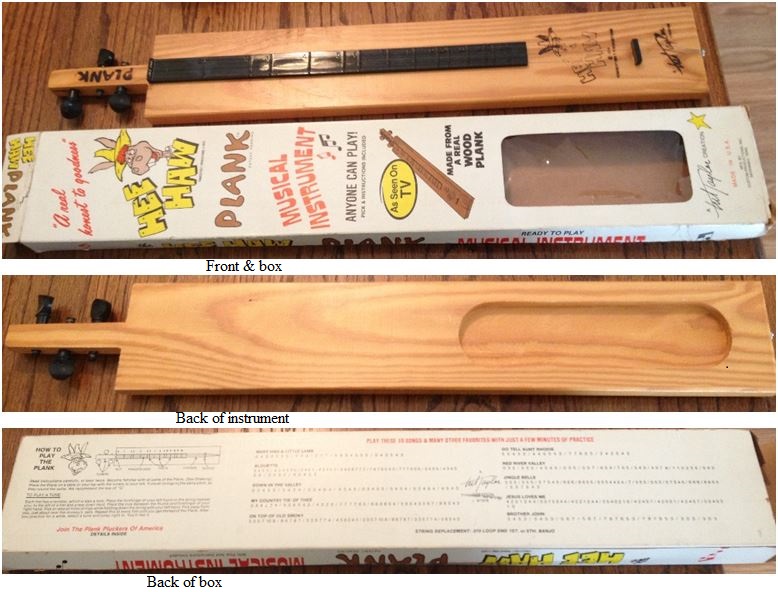
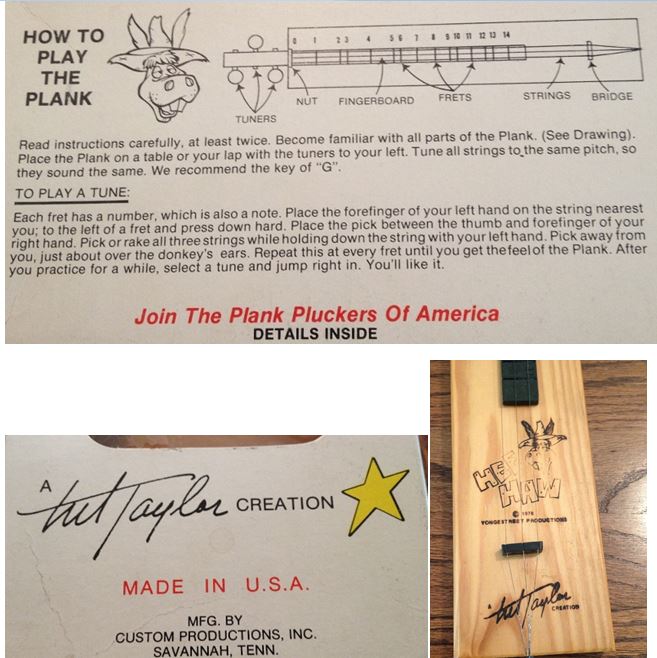
A few weeks ago I attended the Summertown Bluegrass Reunion in Tennessee a vendor had a table full of fiddles. One item was different and so caught my eye (see photos below). I asked the vendor what it was and he didnt know and I remarked to him that it looked like a mountain dulcimer though he didnt seem to know what a mountain dulcimer was. I inquired what he wanted for the item and he said $40. I didnt buy it but latter I almost wished Id bought it.

That evening I looked on EBay and someone had the same type of item, also for $40, but this time if I bought it I also be out the price of postage so again I passed. That one did not sell.

A few days later I looked on EBay and someone else had another one for sale, asking $10. They erroneously called it a plank guitar, as did others on EBay, though the box doesnt call it a guitar at all. Figuring $10 plus postage was reasonable for a curiosity I bid on it and won.

Heres the Ebay description of the item I bid on:

This is a vintage Tut Taylor creation "HEE HAW", Yongestreet Productions wooden PLANK hillbilly musical instrument. Plank measures 24" long x 3 1/2" across, is three stringed, made of wood. It is stamped with the trademark Mule and the "Hee Haw" logo, dated 1976, & also is a Tut Taylor creation. This guitar was once used by blind students at the Tennessee School for the Blind.

I e-mailed Tut and he replied back confirming that the item is indeed a dulcimer and that I should tune all three strings the same (the box says to G).

Mr. Taylor also told me, This was my creation sold by a company in Tenn. They were played on Hee Haw by Roy Clark and Junior Samples.

I have received the item and it plays about like a $10 dulcimer, a bit tinny, but it does play. I mostly bought it for the curiosity factor anyway and am glad I did.

I looked up Tut Taylor, The Flat Picking Dobro Man, on the Internet and learned he was once a repairman at Gruen's Guitars in Nashville (probably the world's premiere vintage guitar shop) and now builds some of the best resonator guitars around.

I also found this about him:

Tut Taylor (born November 20, 1923) is an American bluegrass musician.

Taylor played banjo and mandolin as a child, and began playing dobro at age 14, learning to use the instrument with a distinctive flat-picking style. Taylor was a member of The Folkswingers in the 1960s, who released three LPs; he recorded his debut solo effort in 1964. Later in the 1960s, he played with the Dixie Gentlemen and in John Hartford's Aero-Plain band.

Taylor became a local Nashville, Tennessee fixture. In 1970, he co-founded the instrument shop GTR there, soon after releasing another solo album. He also co-founded the Old Time Pickin' Parlor, a Nashville venue noted for performances of old-time music, as well as Tut Taylor's General Store.

http://en.wikipedia.org/wiki/Tut_Taylor

Tut's webpage: http://webpages.charter.net/tutbro/ and www.tuttaylor.com

Also see the Old Time Pickin' Parlor http://oldtimepickinparlor.com/fr_home.cfm


updated by @david-bennett: 06/11/15 07:37:18AM
John Henry
@john-henry
07/05/13 06:23:42PM
258 posts


I do not know why the makers specified use Mahogany, I do know why I have in the past. As Dan has already pointed out, Honduras in particular is stable and easy to work, and as ff has said, is relatively light for a hardwood. It glues well, and will take most finishes. I have made several dulcimers where Mahog has been the primary construction material, nearly always using one of the more 'conventional' timbers as an overlay. Should be mentioned that some of the associated 'Heinz 57' types of so called mahoganies do have 'harder' qualities, I have an instrument made in the 80's which has a Utile fret board which has given good service and is showing little, if any, signs of wear.

JohnH
folkfan said:

Looked at the Blue Lion site and they do use mahogany for the fret boards, but all of the styles seem to have some sort of overlay in walnut, rosewood, or ebony in the specifications. I'm going to guess that they use mahogany for the fret board for the weight as it is a soft wood and not as heavy as many hardwoods. The overlays due to their hardness give the the slickness, speed, and durability that a fret board make just of mahogany wouldn't have.

I have only one instrument with a solid mahogany fret board, and it's slow compared to cherry, walnut, rosewood, ebony etc.

folkfan
@folkfan
07/05/13 04:55:09PM
357 posts


Looked at the Blue Lion site and they do use mahogany for the fret boards, but all of the styles seem to have some sort of overlay in walnut, rosewood, or ebony in the specifications. I'm going to guess that they use mahogany for the fret board for the weight as it is a soft wood and not as heavy as many hardwoods. The overlays due to their hardness give the the slickness, speed, and durability that a fret board make just of mahogany wouldn't have.

I have only one instrument with a solid mahogany fret board, and it's slow compared to cherry, walnut, rosewood, ebony etc.


updated by @folkfan: 02/12/16 05:33:10PM
Guy Babusek
@guy-babusek
07/06/13 11:35:50AM
96 posts


Good points Chuck. I had a music teacher in college who used to get so frustrated with students who would only practice what they did well. She would say "Why are you practicing that again? You already play that beautifully! Save that for the stage. Work on the hard stuff!!!" LOL

Strumelia
@strumelia
07/06/13 07:58:17AM
2,422 posts


Hey Mark, I just listened to your music clip and left a comment on your page- i really like what you did with your playing.

Chuck Moseley
@chuck-moseley
07/05/13 06:27:28PM
2 posts


Kay, I can't add too much to what you've already been told but I think the best two pieces of advice here are 1) decide what it is you want to do on dulcimer and 2) dedicate 5-10 minutes a day working deliberatly and concentrated on those things that are most challenging for you. In a class with Linda Brockington she told us that practice isn't sitting and playing what you know over and over - it's focusing on those measures you just can't get through and taking the time to work through them. It just takes time. :)
Guy Babusek
@guy-babusek
07/05/13 06:20:43PM
96 posts


Nice points Dusty! I personally have never had the goal to be a professional performer of the dulcimer, but I still want to be a good player. I personally don't think "Just have fun playing" and practicing towards having excellent technique are mutually exclusive. I find I rarely enjoy myself playing as much as when I have really practiced enough to feel like the songs are really right under my fingers and I can "play" them rather than stumble through them. Everyone is different, and I don't ever want to sound like I'm telling anyone how they should practice... just sharing some ideas of what I have found work for me and many of my fellow musicians, based on the original post which was asking for advice as to how to improve as a player.

Dusty Turtle
@dusty
07/05/13 05:55:41PM
1,873 posts


Kay, I think Guy makes a good point here. Many dulcimer players will tell you explicitly not to practice, but to jsut have fun playing. But it appears from your initial comment that you are playing with the expressed aim of improving, and in that light I think Guy's comments are more profound than they appear at first.

Your initial post mentions a range of techniques, from chording and noting (notering?) with the left hand to strumming and fingerpicking with the right hand. Each of those techniques is different and requires its own unique development. Chording will not help you develop technique with a noter, and strumming with a flatpick will not help you develop good fingerpicking techniques. First, you might notice that few of the very best dulcimer players master more than one style. Linda Brockinton is wonderful at fingerpicking, but you will never see her play with a flatpick. Aaron O'Rourke can use a flatpick as well as any bluegrass guitar player in Nashville, but you won't see him fingerpick or use a noter.

For the moment you might indeed want to experiment with different styles to see which one is most alluring to you, but when you practice, you might want to isolate a technique and work on some aspect of that alone. Personally, I have been working recently on developing a stronger pinky on my fretting hand. I have found or developed some scales and arpeggios that necessitate the pinky and I try to run through those as often as possible. Just based on the cleanliness and speed of my fingering, I know I am improving even though I haven't really found songs that reveal my improved technique. Robin Clark posted a video not long ago on advanced noter technique . You might not be ready for the advanced stuff yet, but you might want to take a look at it and see how your own improvement might not necessarily involve chording or fingerpicking but sticking with the noter and trying to master that technique. And rememeber that each of the techniques he demonstrates might take a while to learn well enough to use fluidly in a song.

There are similar resources available for other dulcimer styles. You might want to choose one or two at a time and concentrate on particular techniques rather than playing songs in different styles and getting frustrated that you can't get them up to speed right away.

Guy Babusek
@guy-babusek
07/05/13 05:42:37PM
96 posts


I had a teacher who said "Perfect practice makes perfect." It's more important (in my experience anyway) to have small but consistent practice periods where I work on small sections of a piece before I worry about playing a whole song... The joy of progressing, even very minutely is it's own reward!!!

Guy Babusek
@guy-babusek
07/05/13 05:15:33PM
96 posts


Practice does not make perfect, practice makes permanent. It's regular quality practice that yields exceptional results. I recommend: short periods of practice mindful of technique, at tempos slow enough to maintain consistent rhythm, working on very small sections at a time, and material that is slightly but not overly challenging.
Strumelia
@strumelia
07/05/13 01:49:56PM
2,422 posts


Kay, you might feel a bit better if you read my blog post on the frustration of not sounding better more quickly:

http://dulcimer-noter-drone.blogspot.com/2010/08/why-is-it-taking-so-long-for-me-to.html

Cheryl Johnson
@cheryl-johnson
07/05/13 01:47:00PM
43 posts


Kay, as a life-long musician I feel your frustration. I think it helps tremendously to record yourself over time and it very likely that you are making more progress than you realize or 'feel' like you are making. I think most musicians reach various plateaus over their playing lives and the feelings expressed by myself and other musicians I know are similar to what you are describing.

I do have to add though that two months on any instrument (even dulcimer) is a very very short period of time! Don't be too hard on yourself and enjoy the process. I've been playing guitar since age 8 (I'm 49 years young) and I'm still not where I would like to be. I had a many years long plateau at the upper intermediate level and couldn't seem to break past it no matter how much I practiced. I had to step back and RELAX about it......be good to myself...find the love for my instrument.......and magically a year later I was playing much more difficult repertoire without pulling all my hair out!

So my humble advice is

1) Record to track your progress as this gives you much better and more concrete feedback

2.) Relax and Enjoy

3.) Relax and Enjoy

4.) Relax and Enjoy

Okay you get the picture. It will come!!

Cheryl

Dusty Turtle
@dusty
07/05/13 01:37:32PM
1,873 posts


Kay, all musicians get frustrated with their own progress, so the feelings you are experiencing are normal. One way to avoid the sense that you're not getting better is to record yourself playing a song. You don't have to share it with anyone, but date it and keep it. And keep practicing. After a couple of weeks ora month go back and listen to your recording. You'll probaby know immediately that you can already play much better. That sense of progress can motivate you to keep playing and help avoid the frustration that you seem to be experiencing.

Ken Hulme
@ken-hulme
07/05/13 12:49:25PM
2,157 posts


Kay, that's a wide open question ht demands us to ask other questions. What is your musical background? How many hours a day or week do you practice? What do you mean by better and improve?

1. No one says you have to play chords or fingerpick. Those are not traditional techniques for playing dulcimer after all. I've been playing N&D nearly 40 years, and for more than half of that time I only strummed out, not back and forth. I would learn to fingerpick or chord if you paid me. In all that time I developed my own style of play based on N&D and strumming, including some thing I learned here, ignoring stuff that didn't suit me there.

2. When you say "improve" do you mean increasing your memorized repertoire? Or do you mean playing tunes close to 'performance speed' the way you hear others play? How many songs have you learned, are you trying to learn? Is there a local group against which you're measuring your supposed lack of improvement? What scale are you using to judge your improvement or lack thereof?

3. In any learning situations there are 'plateaus'. You learn new stuff, then you practice the new stuff until you've "got it". Then you look for more new stuff. If you're not adding new stuff to learn; if you're not stretching yourself, you stay at a plateau for a long time, until something or someone comes along and sparks you to learn more/do better, etc.

4. What kind(s) of music are you trying to learn? American folk? Modern? Religious? Celtic?

Playing all of two months and you're worried about improving? At this stage, if you can play 3 or 4 songs well -- that is up to performance speed, from memory -- then you're head and shoulders better than most beginners I know. Chances are you're not that far. But if you can pick out half a dozen songs by reading tab, and they aren't dirge slow, then you're doing pretty good.

Patty from Virginia
@patty-from-virginia
07/05/13 12:20:43PM
231 posts


Kay, finger picking is not that easy so give yourself some time. I've had my dulcimer over a year and I still feel like a beginner. I do believe making progress is a result of spending more and consistent time playing the instrument. I have found that once I learn I song if I continue to practice it I can really improve on my technique. I also try do do at least three verses of a song and not do a one verse wonder. My daughter's piano teacher has my daughter to practice a piece until it becomes second nature. Repetition is the key. She does give my daughter a few songs to work on so that she doesn't get bored. Hang in there. If you are enjoying it then you are doing fine


updated by @patty-from-virginia: 02/13/16 08:15:51PM
Dusty Turtle
@dusty
06/30/13 07:19:28PM
1,873 posts


Dean, this is not really an either/or proposition. If you play dulcimer in a droning style, meaning you play the melody (with a noter or your fingers) on the melody string, then you will learn to play in different tunings depending on the melody of the song. Some songs only work in DAA, some only work in DAd, and some lucky ones can be played in both tunings. Other songs will require DAC or DAG tunings.

If you play across all the strings and play chords, then you do indeed have the ability to stick mostly to one tuning. Thirty years ago DAA would have been the most common. Today it is DAd, as you have discovered with the Desert Dulcimers.

I would second Skip's advice to stick with one tuning at a time for chording. And right now, 90 percent of the chording world plays mainly in DAd. You will find more resources for that tuning and will see more examples of it at workshops, on YouTube, and elsewhere. Mind you, I am not making a value judgment of one tuning over another, merely pointingout that for practical reasons, you will find more help chording in DAd.

But I still encourage you to experiment with other tunings, especially if you are playing in a droning style.

Skip
@skip
06/29/13 10:11:47AM
391 posts


My opinion only, learn one at a time for chording. The chord finger positions will be different between the two tunings, V[A]=101[EAe] in DAD and 100[EAA] in DAA for instance.Many [most?] 'chords' on the MD are onlypartials. There are a bunch of them that will feel awkward at first but get easier over time. You will learn the best way, for you, of fingering/transitioning between chord changes as you progress. Most of the folks I know use DAd for chording but I've heard that DAA may be easier/better for it.

The best tuning I've found for pure chording is DF#AA [1355], four equidistant strings.

Ken Hulme
@ken-hulme
06/29/13 09:37:32AM
2,157 posts


That's a real "can of worms" question, Dean. Everyone is going to give you a different answer. I personally vote for you learning BOTH DAd and DAA -- as well as DAC and DAG and the other modal tunings as well. Neither DAd nor DAA will 'solve' everything, as neith of them is particularly minor in nature.

And did you know, btw, that you can play chords (if you must play chords) just as well in DAA as you can in DAd? And it may be easier on your hands. Check out this article:

http://www.everythingdulcimer.com/articles/31/Learning_Chord_Melody_Style.pdf

Unless you've got two dulcimers, it's probably better to focus on one tuning for a day or a week, then retune and work on things in the next tuning.

phil
@phil
06/30/13 05:50:26PM
129 posts

1920's Parlour Guitar Rescued


Adventures with 'other' instruments...

Sweet sounds from that old guitar. I hope my modern guitar sounds that sweet when it get that old.

Strumelia
@strumelia
06/30/13 04:17:36PM
2,422 posts

1920's Parlour Guitar Rescued


Adventures with 'other' instruments...

Dusty, you are a gold mine of info.

Robin, I didn't have a chance to listen to your clip until now- it sounds so rich and old style- really great.

Dusty Turtle
@dusty
06/30/13 01:41:14PM
1,873 posts

1920's Parlour Guitar Rescued


Adventures with 'other' instruments...

Robin, that guitar sounds amazingly warm and mellow. You have certainly rescued a treasure.

And I'm impressed by your playing as well. I agree with Rob; you sound Jeffersonian, as in Blind Lemon.

There are a few good sources for that mix of hillbilly and race records that was common in the 20s and 30s. I have a CD of African-American fiddlers calledFiddler, Singthe Blues for Me, and there is a two-CD set called White Country Blues that is basically old "hillbilly" singers playing blues. There was a repertoire of acoustic blues music that was common to both white and black performers who, of course, listened to each other. As Rob says, the music was only separated by record company producers and marketing folk. And of course, that whole tradition of Piedmont Blues, which centers on fingerpicking and uses the standard 12-bar form much less frequently, was equally white and black. In fact, some of your playing could easily fit into that tradition.

OK, so I ramble. I guess I'm a ramblin' man.

Rob N Lackey
@rob-n-lackey
06/30/13 11:56:35AM
420 posts

1920's Parlour Guitar Rescued


Adventures with 'other' instruments...

That is one beautiful instrument, Lisa! I'd love to pluck a little on it!

Robin Clark
@robin-clark
06/30/13 11:46:05AM
239 posts

1920's Parlour Guitar Rescued


Adventures with 'other' instruments...

Oh Lisa that's a wonderful instrument And I just LOVE the case!!!!

My little parlor (US spelling!) guitar would have been originally steel strung. It is braced for steel strings and this is typical of the Oscar Schmidt guitars of this age.

Strumelia
@strumelia
06/30/13 11:23:57AM
2,422 posts

1920's Parlour Guitar Rescued


Adventures with 'other' instruments...

There are some folks playing guitars of the 1800's in the Minstrel genre groups, they are amazing and lovely smaller parlor guitars, but must be kept tuned lower as the banjos also were low tuned during the 1800's. They were just not built to withstand modern high steel string tunings. Robin, your guitar was built a little later on, was yours originally strung with gut or steel strings, do you know?

This original 1850's Ashborn guitar is now strung in Nylgut (originally strung in gut), and is regularly played in lower-key minstrel style sessions:

Rob N Lackey
@rob-n-lackey
06/30/13 08:47:24AM
420 posts

1920's Parlour Guitar Rescued


Adventures with 'other' instruments...

Robin, I think the influence and "mixing" of Black & White music predates the recording industry. Indeed there are some (and I think I'm one of them,) who believe the recording industry is what separated the music. They recorded black artists and wanted blues for their "race records" division. There were a few black string bands who were recorded, but, for the most part, string band music was recorded for a white audience. The Mississippi Sheiks, Papa Charlie Jackson, Henry Thomas and Uncle Dave Macon have similar "sounds" on a lot of songs. I believe songs like "Keep My Skillet Good & Greasy," "Georgia Buck," "Pallet on the Floor," "Sandy Boys," "Reuben's Train" are representative of that tradition I like to call (as I read it somewhere) proto-blues: that common music of black and white which predates the recording industry. We play a lot of it in the old time music world, without thinking about it, or even without knowing it in some cases. The recording industry and early record producers have done any of us interested in the history of "folk" music a disservice by dividing up music along racial lines. Wouldn't you love to have a black fiddler's rendition of "Turkey in the Straw" from about 1920?

  591